Stress & Focus · Explainer
Magnesium: Which Form to Buy and Which to Skip
Roughly half of adults fall short of the recommended intake, and the cheapest form on the shelf is the one your body absorbs worst.
 By Julien Malet, · Updated 2026-09-07
Magnesium is a cofactor in hundreds of enzymatic reactions, including ATP production, muscle contraction and nerve transmission. A substantial share of adults consume less than the recommended amount, which makes it one of the more defensible supplements to take — provided you buy a form that gets absorbed.
RDA: roughly 400–420 mg/day for men, 310–320 mg for women.
The forms, ranked
The salt attached to the magnesium determines absorption and side effects. This is the whole decision.
| Form | Absorption | Use it for | | --- | --- | --- | | Glycinate | Good | General repletion, sleep, sensitive stomachs | | Citrate | Good | Repletion, and mild constipation relief | | Malate | Good | General repletion | | L-threonate | Good | Marketed for cognition — see below | | Chloride | Moderate | Repletion | | Lactate | Moderate | Repletion | | Oxide | Poor | Almost nothing | | Sulfate (Epsom) | Topical | Baths, not oral |
Glycinate is the default recommendation. Well absorbed, gentle, and glycine itself is mildly calming — which is why it is the common choice for evening use.
Citrate is the value pick. Nearly as well absorbed, cheaper, and its laxative effect is a feature if you want it and a nuisance if you do not.
Oxide is the one to avoid. It has the highest magnesium content by weight, which makes the label look impressive, and poor bioavailability — a large share passes through unabsorbed, which is why it works as a laxative. It is the cheapest and by far the most common form in budget multivitamins. If a product just says "magnesium," it is usually oxide.
Magnesium L-threonate is sold on the claim that it crosses the blood-brain barrier better and improves cognition. It is based on rodent work plus a small number of small human trials. Mechanistically interesting, not established, and several times the price. Not the form to start with.
Read the elemental amount
This is the trap. A label may say "Magnesium Glycinate 1,000 mg" while providing only about 100 mg of elemental magnesium — the rest is the glycine.
Look for the elemental figure, usually in the Supplement Facts panel with a % Daily Value beside it. That is the number that counts, and comparing raw compound weights across forms is how people end up taking far less than they think.
Dose and timing
200–400 mg of elemental magnesium daily is a reasonable supplemental range, ideally alongside dietary sources.
Take it with food to reduce GI upset. Evening if you are using glycinate for sleep — the sleep evidence is modest but the practice is harmless.
Food sources worth knowing: pumpkin seeds, almonds, spinach, black beans, dark chocolate. As with fiber, food gets you most of the way if you eat it.
Safety
Supplemental magnesium has a tolerable upper intake level of 350 mg/day for adults, and that limit applies to supplements only — not to magnesium from food, which is not the concern.
Excess supplemental magnesium causes diarrhoea first, which is a fairly effective self-limiting mechanism.
The real caution is kidney function. Impaired kidneys cannot clear magnesium efficiently, and hypermagnesaemia is a genuine risk. If you have chronic kidney disease, magnesium supplementation is a conversation with your nephrologist.
Interactions: magnesium can impair absorption of some antibiotics (tetracyclines, fluoroquinolones), bisphosphonates and levothyroxine. Separate doses by several hours. More on interactions.
Taking recovery and sleep one step further
Magnesium repletion is the floor, not the ceiling. Once you are no longer short, the thing most likely to be limiting your sleep and recovery is not another mineral — it is your stress load. Cortisol that stays elevated into the evening keeps you from getting to sleep, and keeps the sleep you do get shallower.
That is a different lever, and it has better evidence behind it than magnesium does for the same outcome.
The layer on topWe own this
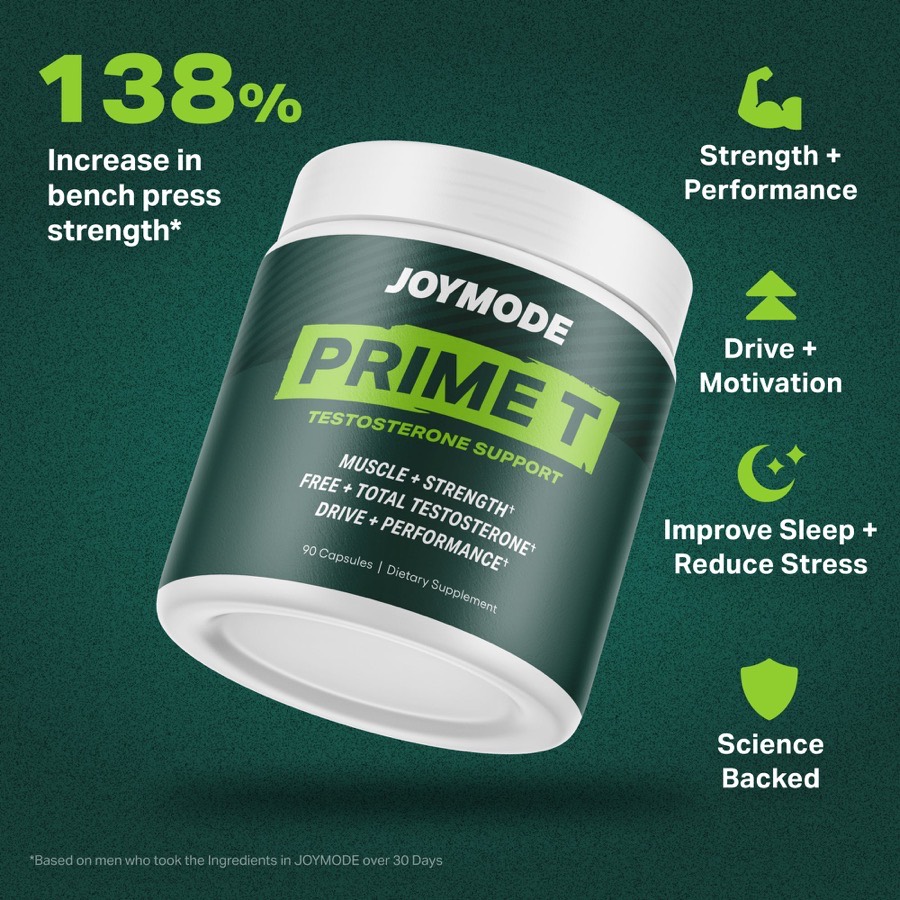
JOYMODE Prime T
700 mg of KSM-66 ashwagandha — above the range used in most of the stress and cortisol trials — plus 125 mg of magnesium and the micronutrients most tied to hormonal health. The stress evidence is the strong part, and reduced stress is a real route to better sleep.
- Format
- Daily capsule, 30-day supply
- Price
- From $49.99
- Dose
- 700 mg KSM-66 ashwagandha · 125 mg magnesium glycinate · 15 mg zinc · 100 mg DIM · 10 mg boron
To be straight about how these fit together, since we own one of them: Prime T is not a magnesium product and should not replace one. It uses glycinate, which is the form this article recommends — but 125 mg is roughly a third of the RDA, below the 200–400 mg supplemental range. Buy a dedicated glycinate for repletion.
What Prime T adds is the ashwagandha dose, and that is where its evidence actually is: multiple placebo-controlled trials showing reduced perceived stress and serum cortisol over roughly eight weeks, several of which also measured modest improvements in sleep quality. KSM-66 is the specific standardised extract used in most of that research, and 700 mg is at the upper end of the studied range.
So the honest structure is additive rather than either-or:
- Magnesium glycinate, 200–400 mg elemental, for repletion.
- Prime T, if stress is the thing actually costing you sleep and recovery.
If you already take a standardised ashwagandha and a multivitamin, you may be buying what you have. Full assessment in our Prime T review.
What magnesium will not do
It is frequently sold for anxiety, muscle cramps and sleep with more confidence than the evidence supports. Correcting a genuine shortfall may help all three. It is not a treatment for any of them, and if you are already replete the effect is likely to be small.
Buy glycinate or citrate, check the elemental amount, and skip oxide.