Stress & Focus · Explainer
Ashwagandha: What the Trials Show, and Which Extract Matters
The adaptogen with the most respectable human evidence. Also the one where the extract name on the label decides whether you got the studied ingredient.
 By Julien Malet, · Updated 2026-09-09
Ashwagandha (Withania somnifera) is the most studied adaptogen and the one most likely to do something measurable. It is also a category where "ashwagandha, 500 mg" on a label tells you very little.
What the trials found
Stress and cortisol. Several randomised placebo-controlled trials report reductions in perceived stress scores and in serum cortisol, typically over 60 days at 300–600 mg of a standardised root extract. Effect sizes are moderate and the trials are mostly small, but the direction is consistent across independent groups — which is more than most of this shelf can claim.
Sleep quality. Modest improvements in sleep-onset latency and subjective quality, again over roughly eight weeks.
Anxiety. Reductions on standard anxiety scales in several small trials. Promising rather than established, and not a substitute for treatment.
Testosterone. Some trials in men report increases, generally small and often in specific populations — infertile men, or men beginning resistance training. This is the claim most aggressively marketed and the one where the evidence is weakest relative to the promise. Do not buy it for this.
Strength. A few trials show improvements in strength and recovery alongside training. Plausible; not large.
The extract is the product
Most trials used one of two standardised extracts, and this is the single most useful thing to know before buying:
KSM-66 — a root-only extract standardised to ~5% withanolides. The most studied. Used in the majority of the stress and testosterone trials.
Sensoril — root and leaf, standardised to ~10% withanolides. Different profile, more sedating in practice, its own trial base.
Unspecified "ashwagandha root powder" — not the same thing. Plain milled root at an unstated withanolide content is not what any of the trials tested, and it is what most cheap products contain.
If the label does not name KSM-66 or Sensoril, or state a withanolide percentage, you cannot connect it to the research. Same principle as reading any label.
Dose
300–600 mg daily of a standardised extract, taken consistently for at least eight weeks. The trials that found effects ran two months or longer; nothing here is acute.
Note the difference between an extract dose and a raw-powder dose — some products list 1,000+ mg because they are unstandardised powder, which is a larger number of a weaker thing.
Safety, and one real concern
Generally well tolerated in trials, with mild GI upset and drowsiness the common complaints.
Liver injury. There are documented case reports of ashwagandha-associated hepatotoxicity — rare, idiosyncratic, and mostly resolving on discontinuation, but real enough that several national regulators have issued advisories. Stop and see a doctor if you develop jaundice, dark urine, persistent nausea or right-upper-abdominal pain.
Avoid or ask first if you:
- Are pregnant — traditionally regarded as abortifacient; avoid.
- Have a thyroid condition — it can raise thyroid hormone levels, which matters if you are medicated.
- Take immunosuppressants — it has immunostimulant activity.
- Take sedatives — additive effects.
- Have an autoimmune condition — same immunostimulant concern.
It is in the nightshade family, so avoid if you react to those.
Products with a real KSM-66 dose
Well-dosed KSM-66We own this
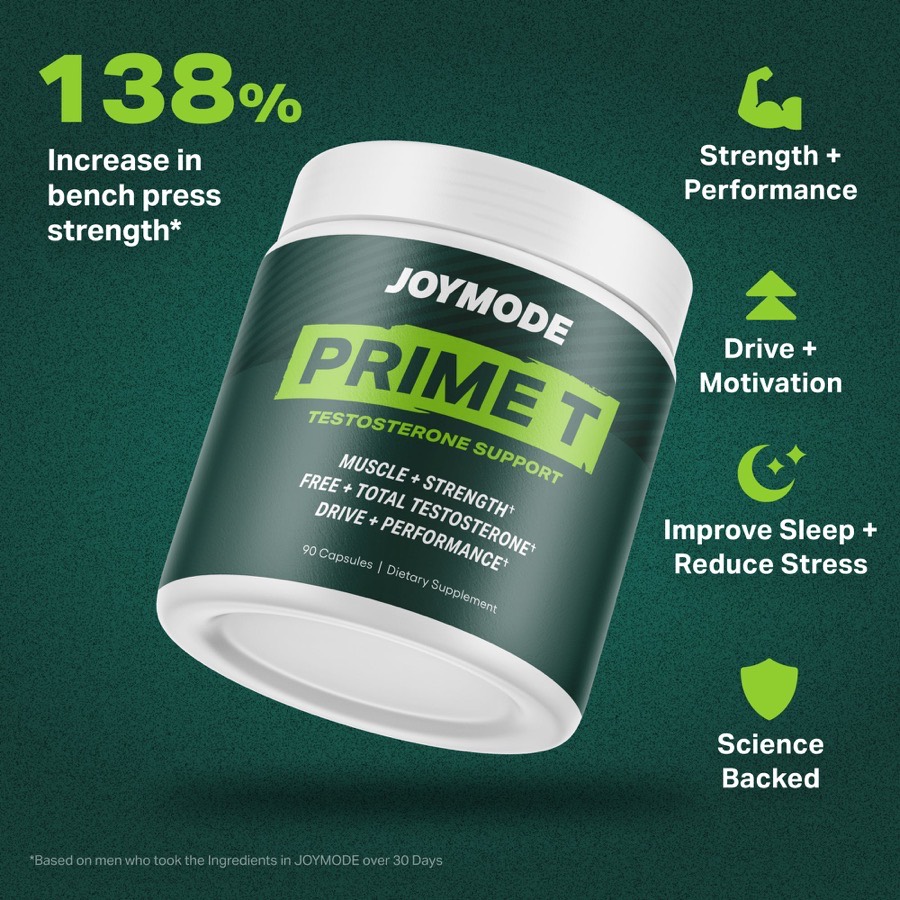
JOYMODE Prime T
700 mg of KSM-66 is above the 300–600 mg used in most of the stress and cortisol trials, and the branded extract is named rather than implied. Sold as testosterone support; the ashwagandha dose is the part with the better evidence.
- Format
- Daily capsule, 30-day supply
- Price
- From $49.99
- Dose
- 700 mg KSM-66 ashwagandha · 15 mg zinc · 125 mg magnesium · 100 mg DIM · 10 mg boron
Worth being precise about what you are buying there. Prime T is marketed on testosterone, and as our review sets out, that is the weaker of its two claims. The stress and cortisol evidence for KSM-66 is the stronger one — so if stress is your actual reason for buying, you are buying a well-dosed ashwagandha product that happens to carry a testosterone label.
Standalone KSM-66 is also available for less if you want nothing else in the capsule.
Where it fits
Ashwagandha is a reasonable thing to try for stress and sleep if you have already addressed the inputs that matter more — sleep timing, caffeine cutoff, training, alcohol. It is not a large effect, and it will not out-run a genuinely overloaded life.
For focus specifically, caffeine plus L-theanine has clearer, more immediate evidence.
Not medical advice.