Sleep · Explainer
Magnesium, Recovery and Sleep: What Overlaps and What Doesn't
Magnesium is genuinely involved in sleep and recovery, most people fall short, and the category still oversells it. Where the honest line sits.
 By Julien Malet, · Updated 2026-09-08
Magnesium is the one mineral that shows up in sleep products, recovery products and stress products at the same time. That is not entirely marketing — it is a cofactor in hundreds of reactions and a substantial share of adults consume less than the recommended amount. But the three claims are not equally supported.
Where magnesium genuinely acts
Neuromuscular function. Magnesium regulates the calcium flux that drives muscle contraction and relaxation. Deficiency is associated with cramping and twitching.
GABA signalling. Magnesium modulates NMDA receptors and supports GABA activity — the inhibitory side of your nervous system. This is the mechanistic basis for the sleep and calm claims.
Energy metabolism. ATP is biologically active bound to magnesium. Every energy transaction in your body involves it.
Protein synthesis. Which is where the recovery claim comes from.
All real. The question is what supplementing does if you are not deficient.
The honest evidence hierarchy
Strongest: correcting a shortfall. If your intake is low — and for a lot of people it is — repletion is worth doing on general grounds, and the sleep and cramp benefits people report are most plausibly this.
Moderate: sleep quality in older adults and in people with low intake. Small trials show modest improvements in sleep onset and quality. Modest is the operative word.
Weak: sleep in already-replete people. Little reason to expect much.
Weak: recovery and performance directly. Magnesium supports the machinery, and supplementing beyond repletion has not been shown to accelerate recovery in well-nourished athletes.
So: a defensible daily mineral with a plausible sleep benefit, not a recovery aid in the way the labels imply.
The form decides everything
Glycinate is the one for this use. Well absorbed, gentle, and glycine itself is mildly calming — which is why it is the standard evening recommendation.
Citrate is nearly as good and cheaper, with a laxative effect that is either a feature or a nuisance.
Oxide is poorly absorbed, cheapest, and the most common form in budget products. If a label just says "magnesium," assume oxide.
And read the elemental amount, not the compound weight — "magnesium glycinate 1,000 mg" may be 100 mg of actual magnesium. Full comparison of the forms.
Where Prime T fits, and where it doesn't
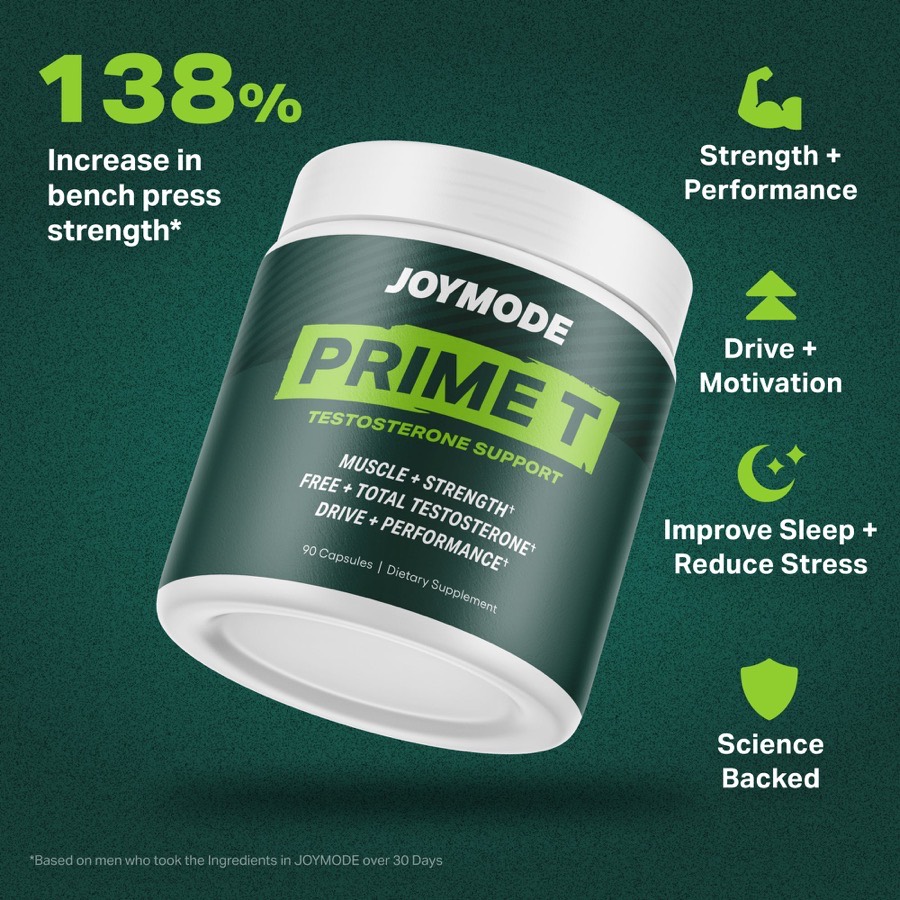
Prime T carries 125 mg of magnesium alongside 700 mg of KSM-66 ashwagandha, and both are relevant to this page — but for different reasons and with different confidence.
Stress and recovery, not a sleep aidWe own this
JOYMODE Prime T
The KSM-66 dose is the strong part — 700 mg is above the range used in most stress and cortisol trials, and reduced stress is a real route to better sleep. The magnesium is a partial dose, not repletion.
- Format
- Daily capsule
- Price
- From $49.99
- Dose
- 700 mg KSM-66 ashwagandha · 125 mg magnesium · 15 mg zinc · 100 mg DIM · 10 mg boron
Being precise, because this is a product we own:
The ashwagandha is the part with the better case. KSM-66 has real trial evidence for reducing perceived stress and cortisol over roughly eight weeks, and several of those trials also measured modest improvements in sleep quality. Stress is one of the most common reasons people sleep badly, so treating the stress is a legitimate indirect route.
The magnesium is a top-up, not a full dose. It is glycinate — the well-absorbed form, not the cheap oxide — which is the right choice. But 125 mg against an RDA of around 400 mg is roughly a third. If magnesium repletion is your actual goal, a dedicated 200–400 mg glycinate is the right purchase and costs less.
It is not marketed as a sleep product and should not be bought as one. Prime T is a testosterone-support formula whose stress evidence happens to be its strongest. Buying it for sleep is buying it two steps removed from the claim.
What actually moves sleep
Ahead of any mineral:
- Consistent wake time, including weekends.
- Morning light within an hour of waking — it sets tonight's melatonin timing. Here.
- Caffeine cutoff eight hours before bed.
- Alcohol, which fragments the second half of the night.
- A cool, dark room.
Then magnesium glycinate, if you want it. Then nothing else.
Not medical advice. Persistent insomnia, or loud snoring with daytime sleepiness, deserves a clinician — untreated sleep apnoea is common, serious, and not a supplement problem.